

Part 5: Legal Marketing Implementation Tip
Gone are the days when attorneys simply practiced law. Today, they face increased competition, shrinking demand for services and increasing supply of professional talent, availability of service substitutes, and marketing of professional services. Marketing can no longer be ignored if small law practices are to survive in the future.
Obstacles to Marketing
Based upon our observations drawn from working with client law firms over the past eighteen years we have concluded that marketing is poorly understood and ineffectively implemented in many small law firms. In addition, the following obstacles are at play:
Time
There is no time for marketing or any firm developmental activities. Production is king and non-billable activities such as marketing are discouraged.
Uneasiness With Marketing
Attorneys are uncomfortable with marketing. This is primarily due to lack of understanding, training, and experience with the process.
Lack of Marketing Understanding
Many attorneys confuse marketing with advertising. Marketing is not advertising. Marketing activities can exist without any promotional components such as television advertisements, radio spots, tombstone magazine advertisements, or direct mail. Marketing is the broader process concerned with the development and delivery of legal services and is part of the firm’s long range planning process. It provides answers to the questions what are we selling and to whom are we selling. It involves maintaining relationships with existing clients as well as creating new relationships with prospective clients. In fact, a major objective of many successful marketing plans is obtain additional business from existing clients.
Focus and Accountability Problems
Frequently law firms experiment with marketing and engage in isolated promotional activities not integrated with the firm’s business plan with the expectation of immediate results after the one-shot activity. The firm engages in fits-and-start activities that are completely unfocused, unrelated to an overall plan, unmeasured, inconsistent and often inappropriate.
Cultural Issues
The typical culture of many law firms discourages investment in long-term developmental activities. The focus is on billable hours and production. Everything else is of secondary concern. The consensus governance model typical in law firms hinders change and timely decision-making at the firm level. In addition, effective marketing in law firms requires marketing at the firm, practice group, and individual attorney levels. This requires effective training, mentoring, follow-up, and accountability at each of these levels.
Reward and Compensation Systems
Most reward and compensation systems focus on short-term production and discourage participation in longer term (non-billable) firm investment activities or projects.
Food For Thought
Marketing is not just about getting new clients. We have seen marketing plans that include the following objectives.
- No-growth. The firm has a stable and profitable client base and the firm cannot service additional clients with adding more attorneys and staff. The firm implements a policy of not accepting any new clients. The firm still actively markets the practice to existing client base in an effort to enhance relationships with existing clients. Seminars are conducted, quarterly newsletters and monthly client alerts, annual client surveys, and annual firm sponsored social functions.
- Diversification. The firm has plenty of business now but is concerned about its dependency upon one client that represents 40% of total firm revenue. The firm initiates a plan designed to diversify client mix. Marketing activities include seminars for prospective (target clients), by-lined articles in targeted trade publications, newsletters mailed to referral sources and prospective clients, speaking at industry trade associations.
- Growth. The firm needs more work. The firm represents institutional clients and believes that it can obtain more work from existing clients. A marketing plan is developed to identify unmet client needs and opportunities as well as cross-selling opportunities. A client survey is conducted. A new opportunity is identified resulting in an ancillary business group being created within the firm to service these needs. Present client concerns about quality of service are identified and actions are taken to resolve client concerns. Client site visits are conducted. An internal cross-marketing program is adopted to help facilitate cross-referrals of work within the firm.
The above examples do not include any activities that are not consistent with professionalism. No advertising…no TV….no radio….no billboards. The majority of the activities listed involved maintenance activities designed to create or enhance existing client relationships.
Effectiveness of Marketing Tools in Order of Effectiveness
Numerous studies have be conducted concerning the effectiveness of various marketing tools. Other than personal injury or other similar commodity-type consumer orientated practices, here are a few of the most successful tools:
- Personal networking and relationship building by individuals
- Solicit and respond to client feedback (Client Surveys)
- Seminars
- Marketing through client trade associations
- Newsletters and solid marketing collateral materials
- Speeches and by-lined articles
Tips for Implementing Marketing in Your Firm
TIP #1: Without an effective marketing infrastructure – marketing at the firm, practice group or individual level is virtually impossible. A few essentials:
- A business and marketing plan for the firm, practice groups, and individual attorneys.
- Someone assigned to coordinate the marketing activities of the firm. In a large firms a marketing director and a team of marketing professionals are typically employed. In small firms appoint a focal person such as the administrator or office manager, or a responsible attorney or secretary.
- A firm identity plan that is used consistently in all external communication collateral marketing materials such as letterhead, business cards, web sites, powerpoint presentations, brochures, newsletters, press releases, media kits, seminar handouts, etc. This plan should be developed to differentiate and reflect the image of the firm.
- Quality collateral marketing materials.
- A content-driven web site. The web site should be database driven to facilitate easy updating.
- A contact database of clients, referral sources, target and prospective clients, media sources, etc.
- Content such as articles, case studies, recent verdicts, that demonstrate the unique capabilities of the firm.
TIP #2: Don’t copycat. Brand yourself. Look for ways to differentiate yourself and your firm from your competitors. Become the only attorney that can do what you do. Make a decision – what do you want to be known and remembered for? Unique services, unique client groups, different service delivery strategy, personal style. Create a five-year plan for goal accomplishment.
TIP #3: Launch a program to obtain client feedback on client needs, opportunities, and quality of law firm services. A follow-up/problem resolution system must be part of the program.
TIP #4: Create the culture and environment. Marketing and client service needs to be incorporated into the culture of the firm. All attorneys and staff should have a role in marketing. Senior partners must walk the talk and consistently, build and reinforce the marketing goals of the firm. Marketing goals and action plans should be formulated and team members held accountable. Over time a marketing mindset will emerge.
TIP #5: Provide marketing training/coaching for attorneys and staff.
TIP #6: Improve time management skills of everyone in the firm.
TIP #7: Establish daily marketing goals and measure your personal marketing results on a daily basis. Analyze successes and failures.
TIP #8: Get out of the office. Visit a client’s place of business once a month.
TIP #9: Write an article every other month.
TIP #10: Take a client to lunch once a week.
TIP #11: Improve your communication skills with both clients and office teammates.
TIP #12: Prepare and submit press releases monthly to clients, prospective clients, media and the general legal community.
TIP #13: Learn how to become “solutions orientated” and become a consultant to your clients as opposed to simply their attorney. Solutions may involve activities and services other than legal services. Think out-of-the-box and outside of typical frameworks in which you are comfortable.
TIP #14: Explore the feasibility of ancillary businesses.
TIP #15: Get your newsletter on track and on a consistent basis (at least quarterly).Send via e-mail.
TIP #16: Join a client’s trade association and make contributions in the form of articles, speeches, conference attendance, etc. Learn the client’s business from top to bottom.
TIP #17: Establish a marketing library to include general materials on marketing as well as specific publications related to your clients business.
TIP #18: Institute quarterly client service/marketing brainstorming sessions. Break the rules. Encourage all members in the firm to think out-of-the-box and innovate. Look for new ways to solve client problems. Look for new solutions. No topic should be initially be considered out-of-bounds.
TIP #19: Consider using a client advisory council. Once a year hold a client advisory council forum in which the firm solicits feedback from clients.
TIP #20: Join a client’s trade association and make contributions in the form of articles, speeches, conference attendance, etc. Learn the client’s business from top to bottom.
TIP #21: Create a new client niche and market your unique experiences intensely. Strive to develop a national reputation in the niche.
TIP #22: Focus your marketing on no more than 2-3 key specialize practice areas in which you can differentiate yourself.
TIP #23: Develop and practice the following leadership behaviors:
- Formulate and articulate a shared vision for the firm.
- Lead the fight for constructive organizational change.
- Empower and develop other attorneys and support personnel and enable them to accept responsibility and make decisions.
- Develop and foster an effective management team.
- Develop problem solving and multiple options thinking skills.
- Take intelligent risks.
- Make tough decisions.
- Establish both firm goals and performance goals for all attorneys and support personnel.
- Seek input from others.
- Coach and develop others.
- Confront and deal directly
- Hold everyone in the firm accountable for actions and performance.
TIP #24: Conduct an annual firm retreat. Include both attorneys and staff. The first few items on the agenda should include a review of:
- Things that the firm did well and could have done better
- Things done poorly
- Things the firm should of done but did not do.
TIP #25: Do it now. Marketing and other developmental projects affect the future of your practice and are just as important as short term production and billable hours. David Maister says it best. “Your billable time is your current income….your non-billable time is your future.”
Part 2: Your Legal Marketing Plan
Table of Contents
If you’re like many small and mid-sized law firms, you’ve at least thought about developing a marketing plan for your law firm.
At its most basic, a marketing plan defines what you plan to do to market and grow your law firm and how you plan to do it.
For some firms, the idea of writing down a plan seems daunting. Or maybe It seems like an unnecessary exercise when you already are doing some level of marketing.
Taking the time to write down a plan seems superfluous.
But, trust us on this one – a defined marketing plan is as critical as a business plan.
You need a thought-out strategy for not only what marketing actions your law firm will engage in, but how you’ll do them, who will do them, when they’ll be done–and how you’ll measure the success (or lack thereof) of your time and money.
Executing on marketing without a cohesive plan will likely waste your time and your money.
And worse yet: it may turn you off of marketing altogether as a means to grow your business.
These opportunity costs could kill growth for your firm.
But fear not, a marketing plan is not difficult to develop. It will take some critical thinking and just a little bit of your time.
And, your law firm marketing plan should be thought of as a living document. You’ll update, amend and change it over time.
Importantly, you don’t need to fear that it will be a crazy-long, time-intensive process like building a business plan.
Your marketing plan doesn’t need to be a 30-page document. In fact, it shouldn’t be.
It should be a concise, cohesive document of a page or two that clearly outlines the goals, practices and tactics of your marketing plan.
In this article we’ll cover how to best write, and execute on a killer marketing plan. We encourage you to use what you learn here to develop a marketing plan for your firm. You can use our Sample Marketing Plan as a template–or create your own.
Let’s get started.
Marketing Plan Why, What and How:
Starting at the Top.
When planning the marketing plan for your firm, it may seem natural to jump right into the specific to-do’s for your law firm.
Jumping right into advertising.
Or putting together your email newsletter.
These tactical components are the how of your marketing plan.
But starting here is starting backwards: When developing your law firm marketing plan, start with why and what.
Marketing Plan Framework
There’s not necessarily a right layout or framework for a marketing plan, but we find it useful to break your plan into three distinct sections, starting with the high-level, strategic and working its way down into the tactical, nuts-and-bolts execution of your marketing plan.
Or, a section for: Why, What and How.
WHY: The purpose of your marketing plan. What are the strategic and definable goals of your plan?
WHAT: What will your marketing plan actually entail? What ongoing marketing endeavors will you do?
HOW: Once you’ve defined what your firm will do for its marketing: How will you do it? How often? Will you outsource some or all of it?

WHY: Purpose & Goals
When developing your law firm marketing plan, start with Why.
It may sound obvious or unnecessary, but you should clearly define the purpose of your law firm marketing plan.
The purpose of each initiative and activity.
The purpose of one law firm’s marketing endeavors are not necessarily the same as another’s. We’ll use the fictitious firm Collins & Whitmore to represent the law firm we’re defining a marketing plan for–pretend this is your firm.
When crafting the Why part of your law firm marketing plan, define the purposes of your marketing plan, which may include (for example):
- To establish Collins & Whitmore as an authority on the practice of Family Law in California.
- To establish Collins & Whitmore as the clear go-to for Mother’s Rights in New York.
- To ensure Collin’s & Whitmore’s online presence and messaging is consistent with the firm’s real-world prestige.
- To generate “Sales Leads”, or prospects: new prospective clients.
- To generate “Marketing Leads,” or followers: your website audience and readers of your content (who may become clients later).
- To generate new clients and increase caseload by X% annually.
Notice that each of these examples are fundamentally different.
But, the components of your law firm marketing plan, the What’s and How’s, will be actionable projects and rhythms to achieve these goals, and certain marketing activities can (and should) drive to one or multiple goals in your marketing plan purpose.
Goals
In the Why section of your marketing plan, you should define quantifiable goals, where possible.
“Establish your firm as a thought leader in your practice area,” isn’t really quantifiable (though critically important), so we’ll leave it where it is in the Why section.
“Generate X new clients / month” definitely is quantifiable.
So, as part of an actionable, measurable law firm marketing plan, let’s define it.
How many new leads (prospective clients) would you like each month?
What quantity, in a month, would you consider “good,” or a success? How many would be “not good enough”?
It’s important to define the goalposts with lead (and client) generation so you have a way of knowing if your marketing plan is succeeding or needs more work. If you’re just getting started and don’t have a good starting point, just come up with an educated guess to start.
You can (and should) refine your goals over your first few quarters.
While there’s not necessarily a right or wrong way to display and represent “bad”, “good,” and “great” numbers for generating new leads for your firm, what we’ve found helpful is to define “stoplight” metrics that define what you consider bad, good and great. Below is a sample.
Dark Green (DG): “Excellent” – Exceeded your goal by a healthy margin
Light Green (LG): “Good” – your goal, or ideal number of new leads
Yellow (Y): “Warning” – short of your goal, attention required
Red (R): “Critical” – far short of your goal, serious attention required
Below is a sample of stoplight metrics from a law firm marketing plan.

A key to assigning stoplight (or any) metrics is setting proper expectations.
If you practice in a highly competitive market (in terms of practice area and geography), and are working with a modest marketing and advertising budget, your expectations and metrics should reflect that.
Conversely, if you practice in a very niche space and plan to invest an appropriate amount in marketing, you can set the bar higher.
A good law firm marketing agency can help you set proper benchmarks. And–if you’re in your first 6 months of a marketing plan, know that whatever metrics you define are an educated guess, and may have to be adjusted (down or up) based on the results of your campaigns.
Conversion
Finally, New clients.
Leads are good, but really your law firm marketing plan’s purpose is to yield new clients.
As you likely know, not all leads are created equal. Some prospects are time-wasters or tire-kickers.
Others are serious about finding a good lawyer.
You should track how many leads you generate, and how many new clients you generate. Then, you’ll be able to track conversion: the rate at which you convert leads, prospective clients, to actual clients who put down a retainer.
Conversion rates vary wildly between firms and practice areas. Some consider a 10% conversion amazing. Others shoot for 20%. Others for 50% depending on the marketing activities (i.e. referrals shoot for 60%, advertising for 40%, etc.).
It all depends on your market and your goals.
It’s more important that you, over time, track and calculate conversion than you necessarily define a perfect conversion rate goal right away. (We’ll cover tracking results a little more later.)
Sample Law Firm Marketing Plan
To help you get up and running with a marketing plan for your law firm sooner, we’ve developed a sample you can use. <click here>
Part 3: Establish Your Legal Marketing Rituals
The Top 10 Law Firm Marketing Techniques

This is part of the Digital Marketing Insights series — featuring tips, analysis and recommendations from marketing experts on how to become successful online.
Marketing techniques are all about acquiring new clients. A lot of this can be done onlinetoday. And the good news for marketers is that marketing budgets are growing steadily, with an increase of 6.7 percent during the last year.

Every type of business and service needs to be engaged in marketing their brand. This includes online legal services and law firms.
Here are ten surefire marketing techniques that can help a law firm market their brand most effectively:
-
-
- Previous Clients Are Potential Current Clients
Never discard client contact information, no matter how old or possibly out of date it may seem. All former clients need to be contacted, preferably by phone if you have the manpower and means, or by mass email campaigns, to let them know you are still in business and ready to service their needs. Offer a discount for returning clients. A free consultation on wills or a
-
-
- , for instance.
- Set Aside a Minimum of 2.5 Percent of Your Revenues to Marketing
-
- That 2.5 percent cut doesn’t include the wages of the individuals you will have employed to execute the work. This money is allocated to creating effective branding, on getting clients or customers out to luncheons. These are all effective marketing techniques. Indeed, you must invest at least 2.5 percent in marketing; otherwise you are wasting your time.
- Use Multimedia Such as Videos and Pictures to Liven up Your Website
-
- Producing videos isn’t hard at all, and can be done very easily. In fact, without video, you are actually missing out on an excellent marketing strategy. Your branding is improved, and you become more noticeable. Your message can be conveyed more effectively.
- Word of Mouth Is a Brilliant Thing
-
- One of the most powerful marketing forces is word of mouth, meaning that satisfied clients will refer their colleagues and friends to you, which can be more effective than many other marketing techniques. You must try to increase word of mouth referrals, and while you can’t control word of mouth directly, you can surely affect it indirectly by the service you give, and by not being afraid to accept and act on negative client input.
- Trade Associations Are Great Places for Networking
-
- At the end of the day, networking is what gets you new contacts and ideas, which is why you should attend trade associations in your city, county, and state, where hundreds of potential clients may be attending. You can simply ask your clients about the meetings they attend, and request them to introduce you to others, so that you can attend these associations and score more clients.
- When Results Are Measured, Results Improve
-
- Make sure you are able to track the results of all your marketing campaigns. Those that bring in clients that result in billable hours obviously should be continued, and perhaps expanded. Those that bring in very few, or none, should be discontinued.
- B2B Emailing Lets You See Results Right Away
-
- You can see things like how many have opened your email and what their response is. As mentioned earlier, a simple B2B campaign would be contacting former business clients by email and offering them a discount if they use your services again within the next month.
- Make Your Blog More Anecdotal, Less Promotional
-
- Don’t write “We can give you such and such service.” Instead, write “We helped Bill Jones write up a living will that helped his estate avoid a costly probate contest.”
- Be a Greeter at Civic Functions
- It’s a little too obvious if you pass out your card with your handshakes, but you’ll get quite a few inquiries as you greet people as to what you do. Don’t just say “I’m an attorney.” Say “I win court cases.”
- Explore Social Media Marketing
Social media needs an article all its own to begin to suggest how it can help you market your law firm brand. Facebook and Twitter offer invaluable marketing techniques for any law firm willing to make the effort. Hire an in-house social media manager, if you can afford it. Otherwise, outsource it. But, above all else, don’t ignore social media or downplay it. Remember that in marketing you must choose between boredom, shouting, and seduction. So keep these seductive techniques in mind for your law firm.
Part 4: Develop Your Public-Facing Brand
Law firm marketing is more competitive than ever, and filled with the challenges of managing multichannel, digital marketing. Here are 9 lawyer marketing tips, ideas, and strategies that will boost your visibility and get leads ready to hire an attorney contacting you.
Law Firm Marketing Tip #1: Design a Trustworthy, Professional, Mobile Friendly Website
For a law firm, the center point of your marketing is your website. It’s the destination your campaigns are driving potential clients to.
When it comes to website design, focus on ease of use, professional image, and clarity. The most effective designs are clean and modern. They make it easy to find information. And most importantly, they communicate the value your attorneys deliver clients.
Here is an example law firm website template from our UXI® designs:

Of course, today, your template must be mobile responsive. Test your site to make sure it’s easy to navigate and fill contact forms via a phone.
You can expect that your website will be the first impression your firm makes on most new clients. Make sure it meets your standards.
Law Firm Marketing Tip #2: Develop Your Value Proposition
The biggest problem most law firm websites and marketing content have is that they are too vague. They fail to clarify the specific benefits of their services, how they make clients lives easier, or why they are a better choice than the competition.
Do a search for lawyers in your area, and probably half the sites will emphasize that “we care about our clients” and that “our clients are our priority”.
Well, I certainly hope so.
These feeble bromides won’t motivate someone on the fence about hiring a lawyer to act.
Instead, you need to hit them with a crisp value proposition that’s specific about what you do and how you solve their legal problem. A statement that distinguishes you from your competition so a lead has a clear reason to choose your firm.
For example:

This firm is specific about being disability attorneys. They distinguish themselves from other firms by noting how their experience will help you get better benefits. They offer two easy ways to get specific information on your case.
To develop your value proposition, answer the unspoken questions on every client’s mind:
- What do you do? Can you help me?
- What’s in this for me? Why are you worth it?
- Why should I choose you instead of another law firm or method of solving my legal problem?
One of the biggest competitive advantages in marketing is clearly communicating your value. Work on getting a tight statement and supporting content that you center in your marketing.
Law Firm Marketing Tip #3: Rank On Page One of Search
One of your main goals must be to appear on page one of search when people look for lawyers in your area. Searches like this generally indicate strong intent to get legal help, so the traffic is valuable.
There are three ways you can show up on the search result page. The first is pay per click advertising or PPC. This is where you bid on auction systems like Google Adwords to appear in top positions on the page. Your budget and placement will depend on your competition. PPC ads give the most control over ranking, ad content, and landing page.
The second is connected to your Google My Business account. You create this through Google to get location based search results (it is also Google Maps). Optimize for keywords, and photos/business details, and get client reviews to increase your ranking. This is a free listing/clicks.
Last is your organic listing, related to your website SEO. This is the direct listing of your homepage domain, also free ranking/clicks. Optimize your website content for legal keywords, add fresh content to your blog, earn links, and get social media traffic to your website to increase your ranking.
Over time, you have the chance to be in all three spots on the search result page:

Pro Tip: Create Custom Landing Pages
Your law firm may handle many types of cases. You can create the impression of specialization by creating a custom landing page for each area of law you work in.
For example, say you have an attorney who specialize in trucking accidents. Run ads specific to those keywords, then have the ads go to page designed to match the legal service:

This gives you a specific value proposition for this legal service. Add content to the page and you can rank for it organically as well.
Law Firm Marketing Tip #4: Build a Positive Online Reputation
What you say about your legal services through your value proposition is important. It’s the most persuasive content you’ll develop.
However, it’s arguable that this is not your most persuasive content overall.
Today, online reviews, written by your clients about their experience with you, is probably the most influential content on new prospects. They seek reviews, expect to find them, and trust them.
Just a look at the search results page we showed above shows the immediate role reviews play. For one, the top organic spots are held by law review sites like Find Law, Avvo, and also Yelp. The content on these sites is all driven by reviews.
And when you view Google Places, review star ratings are highly visible:

Consumers today like to verify the reliability, service, and effectiveness of businesses they deal with. This means you need to start gaining reviews from your best clients to improve your online profile.
Two main things come into play here. The first and most important is your legal service itself. Every time you exceed a client’s expectations, you boost your reputation (and marketing). Every time you cut corners or disappoint, you hurt your reputation.
Second is what we call reputation management. This is where you take an active role in getting your best clients to leave you reviews while keeping any negative reviews from being predominant on your profile.
This starts with encouraging happy clients to write you a reviews. Kindly ask for a review. Follow up with an email request, providing links to sites where you need more reviews. Don’t be pushy, but make sure clients know you’d appreciate it.
Then, monitor what’s said about you online. Make sure to challenge anything that’s false or slanderous. Respond to constructive criticism with thanks and a pledge to fix the problem.
Make efforts to get reviews working for you. Both a poor profile or no profile will hurt your marketing.
Law Firm Marketing Tip #5: Use Video and Visuals
Online consumers tend to glaze over large amounts of text, especially with complex legal topics.
Use videos and visual content to help get your point across.
For example, an introductory video can convey your value proposition effectively:
Likewise, an infographic will keep your audience engaged:
 This content always carries over well to social media.
Law Firm Marketing Tip #6: Market Your Expertise
Legal issues are confusing to the general public. We don’t get it, so we hire lawyers.
But few people today go into serious situations without getting some background. It’s so easy to research things online today that people can brush up on even complex topics.
You can use that research process to your marketing advantage. Create blogs, publish on Medium and LinkedIn, and connect with local associations to help educate people on current legal issues.
Share your insight and expertise. Don’t turn it into an ad, don’t expect anything in return. Just create content to help people.
In doing so, you can expose your brand and build your reputation. People will get to know and trust you.
And you do get something in return. Google love useful content as articles or videos, and ranks it on search and YouTube. As people do searches on legal issues, you can rank and get your name in front of them.
Trust is a big factor with attorneys, and people who are willing to educate their clients to help them better navigate their situation earn trust. Be the go to person and it will payoff with your marketing.
Law Firm Marketing Tip #7: Tap Into Social Media
Social Media is now such a dominant player in the online world that no business can ignore it.
Start by creating a Facebook page for your law firm and use it as a way to update people on what’s happening with your firm. Share your blog posts, videos, and other informational material. Also, curate content from around the web on legal issues that you think will be of interest to your audience.
You can also use Facebook’s powerful targeting tools to run ads to your target demographic. This will probably remain more brand advertising than direct response, although you can try retargeting with Facebook Lead Ads.
Also, be active and responsive on Facebook messenger. More and more people are using messenger instead of calling businesses, so this can be a good place to make initial contact with leads.
Next, have your attorneys create their own LinkedIn profiles. For professional services networking, LinkedIn is the best social media platform. You can also create a business profile for your firm, but you’ll gain more quality connections as individuals. Like Facebook, post relevant, useful legal content. Also, each attorney can publish articles via their page.
As a law firm, don’t expect social media to be your biggest marketing channel. You are at a disadvantage over other types of businesses because people don’t want to share things about their legal problems online. But you want to be there, and it doesn’t take a lot of effort to add content and interact with your audience.
Law Firm Marketing Tip #8: Have a Strong Intake Process
There is nothing worse than going through all these steps to get leads to contact you, only to lose them because of a poor intake process.
Online consumers are impatient. You don’t have days to respond to website forms or voicemails. You need to get back to people fast. Assume that people are comparing multiple firms and make it your goal to get back to people first (the first to get back most often wins the business).
Make sure your people have polite, professional phone skills. Be open about providing information and options in your consultations. Have a polite but consistent follow-up process for people who are on the fence.
Lead generation is competitive. When you get a hot lead, make sure you turn them into a client.
Law Firm Marketing Tip #9: Put Software to Work
By now, you’re probably thinking all this sounds like a lot of work as well a complicated headache you don’t need.
Indeed, online marketing does get involved and time consuming. It’s also hard to track with respect to ROI because of all the channels.
Solving this problem for business like law firms is the purpose behind Marketing 360®. Our marketing software, CRM, and email marketing platform allow you to put all your marketing, advertising, design, client contacts, budgeting, and overall strategy into one platform. Even better, this is led by a marketing executive that makes sure all this technology is making connections with the right people.
Contact us today to get a free demo of how our marketing software works and to get a free website mockup for your firm. You can also get a software overview here.
Here are more lawyer marketing tips. Good luck!
Part 5: Make the Internet Your Best Friend & a Profit Center
1. Run a smart Google Adwords campaign
For those law firms who need to generate business right away, there is probably no better solution than marketing your law firm through a smart and efficient Google Adwords campaign. More people than ever before are clicking on paid search ads, especially since Google removed the right side ads and added another ad up top. The first 4 results on a page are now Google ads!
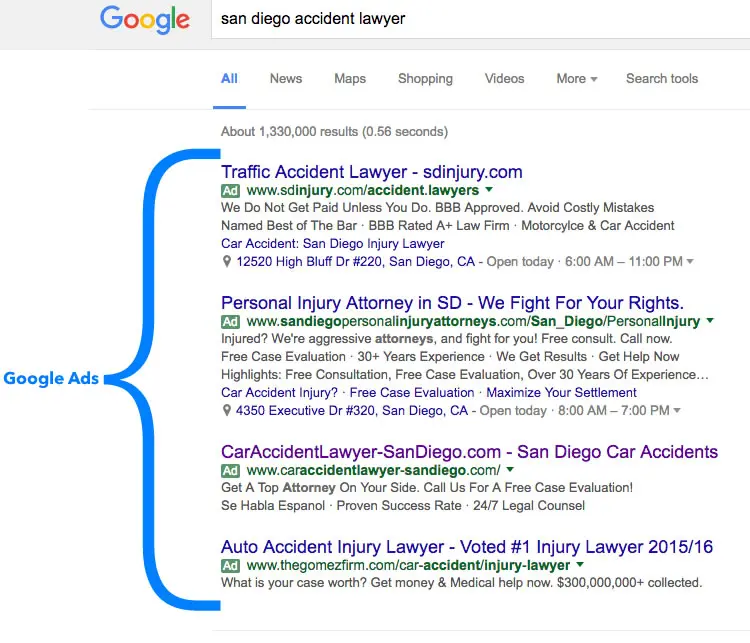
If you are asking yourself, “Do people click on paid ads?”, yes they do. In a click test we ran recently, more of the test participants clicked on the first 3 paid ads than the first 3 organic search results.

So what is the key to making paid search work? Choosing the right company to run manage your Adwords campaign. Choose the wrong company to manage your PPC and you might as well light a match and burn your money. It’s especially important to keep that in mind if you have tried Google Adwords in the past and it didn’t work. It absolutely does work but the vast majority of law firm Adwords campaigns are run improperly and inefficiently. If you have a company managing your Adwords campaign that knows what they are doing, it can be incredibly profitable and you can start generating leads in as little as 24 hours!
2. Use custom landing pages for your Adwords campaigns

Instead of sending visitors to a your site, consider having a custom landing page created to help increase the conversion rate. A custom landing page can make you look like an attorney who specializes in the types of cases you want to generate. Additionally, it often provides less options for where a visitor can click, meaning their focus will be on whatever you put on that page. An intelligently designed landing page can lead to more calls or case evaluation requests being generated.
One of the biggest problems with failed paid search campaigns is the landing pages used together with the ads. Whether it’s a page on your site or a custom made landing page made specifically for your ads, you never want to send traffic to a page that gives off a poor reflection of your law firm, provides a bad user experience for site visitors, or both. If you don’t think that users care about the design of your site, think again. Sending visitors to a page that doesn’t convert well is a big waste of money.
3. Hire a really good SEO agency
When you have a successful search engine optimization campaign, there aren’t many types of marketing campaigns that will result in a lower cost per conversion.

Of course, this takes time so if you need cases right away and don’t have the patience or the budget than SEO may not be for you. Depending on what types of cases you want and where geographically you want to get them from, it’s important to understand that this can take a year or longer to start seeing results. In less competitive markets or campaigns, it could be as short as a few months to get ranking and start generating leads. If you want to generate personal injury cases in Manhattan or compete with the firms going after mass torts on a national scale, this will take longer due to the level of competition on Google’s 1st page. Choosing the right company isn’t easy. If you are wondering how to choose the right law firm SEO company, read about how to choose the right one here. There are a small percentage of good law firm marketing companies out there, so choose wisely. Not only will hiring the wrong company be a waste of time and money but it can also lead to your website getting penalized in Google search, making SEO even harder and more expensive for future campaigns. Just remember, if it sounds to good to be true is most likely is so never fall for guarantees or low cost services. There’s a reason why good SEO is not cheap.
4. Create valuable content on your site
Law firm websites have a reputation for having incredibly boring content. Be different and create valuable content that is “share worthy” and it can help link building campaigns (important for SEO), as well as potentially provide you with some PR (more on that below). For example, we recently helped one of our clients to conduct a study that analyzed over 2 million accident records in the state of Texas. We identified the most dangerous intersections in the state based on the data and shared that information with local media outlets. This led to a giant spike in traffic to his website after he was featured on multiple media outlets and websites. Many of those outlets linked back to his website to share his study which is good for SEO as well.

While this type of content is not practical for all firms to create, valuable content can also come in the form of simply answering questions that many people have about the type of law you practice. Creating answers to who, what, when, where, why questions is valuable content that may lead to more traffic and more leads. How would you like your website to the the “answer” given by a voice search on Google Home or the Amazon Echo? Voice search is growing at a rapid pace and by 2020, experts predict that 50% or more of all search will be mobile search.
5. Run a PR campaign
When I say PR, don’t get this confused with a press release. Journalists stopped caring about the typical boring page long press release a long time ago. I’m talking Public Relations. Do something that the press cares about and it may help to bring awareness for your law firm if the media covers you. The example above about the dangerous intersections? That led to him being featured on multiple television news reports and interviewed on camera by multiple stations. Notice the screenshot from NBC news below.

Having multiple press mentions is great for your brand when the messaging tied to it is a positive one, as was the case here.
6. Use retargeting campaigns
You know those ads that follow you around after you’ve visited a site? Those are retargeting ads (also called remarketing ads). Most people who search for a lawyer online take multiple days to select the law firm they hire. Most will visit your site and compare you to multiple other law firms they find online. Often this selection process takes multiple days so reminding them of your law firm as they browse the web can help keep you top of mind. If you are spending money on paid search or organic SEO, then using retargeting ads is a must.
7. Improve your intake process
Are you losing potential clients because of a poor intake process? Even after 10 years in law firm marketing it still surprises me how bad some law firm’s intake process is. Whether it’s an unfriendly sounding receptionist answering calls, calls that go to voicemail or simply not responding to leads in a timely manner, you should be analyzing your process and working to make it better. Law firms with a really strong intake process in place are the ones that are able to convert more leads into actual clients. Keep in mind, the average person looking for a lawyer online is comparing you to multiple other firms. Law firms that have a streamlined intake process in place and return calls or online case evaluation requests quickly are the ones that do best.
8. Use video to help improve conversion rates
A Princeton University study in 2014 polled adults on how they viewed certain professions, including lawyers, chief executive officers, engineers, accountants, scientists, and researchers. Any guess which profession rated lowest on warmth and trust? You guessed it. Lawyers.
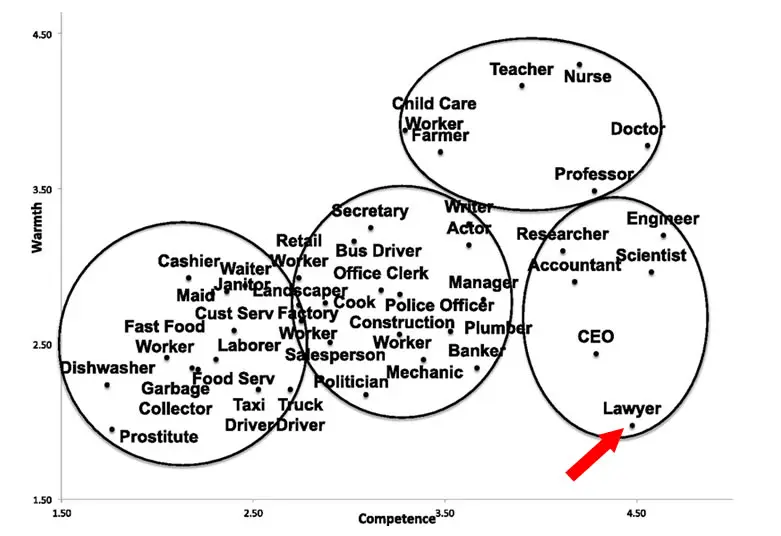
So how do you combat that perception? One great way is through video. Video can be a powerful way to gain the trust you need from your website visitors and help to improve conversion rates. Below is a video we created for a Panish, Shea & Boyle in Los Angeles that aimed to increase the level of trust and approachability of the firm (as well as to improve) website conversion rates.
Just keep in mind, not all video is good and in many cases it can hurt conversions. Low quality videos with poor lighting, bad sound or weak messaging are just going to give visitors a very poor perception of your law firm. Hire a professional to handle this for you or you will end up negatively impacting your conversion rates.
9. Ask clients to review your law firm
Reviews are incredibly important to your business, maybe more than you know. We recently completed a study on “How Consumers Choose Attorneys Online” and one of the parts of that study focused on law firm reviews. Over 80% of participants said a law firm would need to have at least a 4 star review online before they would consider hiring that firm!. So, no matter how great your website is, people will still go to Yelp, Google, Facebook, Avvo, etc. to see what kind of reviews you have online before they hire you. Make it a practice to ask clients to review your law firm, although keep in mind Yelp does not approve of asking for reviews. If you do want to encourage more Yelp reviews without actually asking, consider adding a Yelp badge on your website, add a link to your Yelp account in your email signature, add a “People love us on Yelp” sign/sticker in your office.
Additionally, Google local maps listings rely heavily on reviews. Note the review stars below?
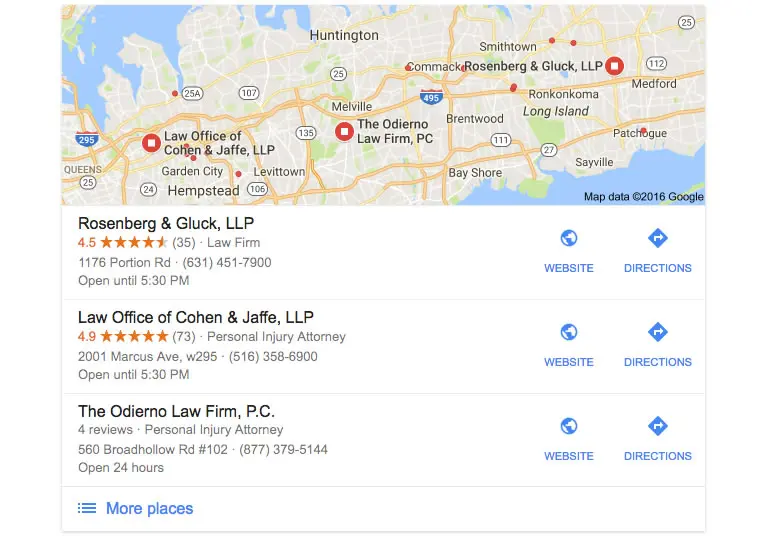
It’s not just a matter of the number of reviews you get either, credibility also matters to Google. Notice the #1 position here has 35 reviews with an average of 4.5 stars and the #2 position has 73 reviews with a 5 star average. If it was simply about review totals then we would see the 2nd listing placed in the first position. There are many other factors at play when it comes to Google maps rankings. While we are on the subject, it’s important that you do not try to game Google reviews. There are companies out there offering to get reviews for your firm but they are often fake. Aside from being unethical, this has the potential to cause you to be penalized and would prevent you from ranking at all. I’ve already seen multiple law firms fall out of the rankings in Google maps as a result of fake reviews.
What if you get (or have) negative reviews about your law firm online? That’s ok, no business is perfect so the odds are that you will get negative reviews at some point in time. It’s important that you respond to them online so consumers hear your side of the story as well.
10. Improve the messaging on the most visited pages of your website
Which pages in your site are the most highly trafficked? If you don’t know, you should. By looking at Google Analytics, you can find out which pages are visited most often.
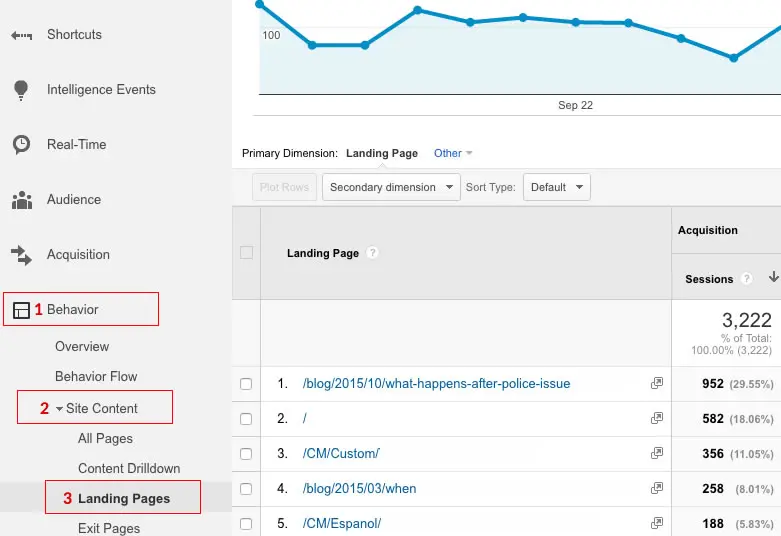
What is the messaging like on these pages? Are they built with conversion in mind? Are there selling points that give a visitor a reason to call you instead of your competitors? Is there a call to action? Make sure that these pages are set up to help increase your conversions. Focus on what your visitors really care about. They don’t care about where you went to school. What consumers care about most is what kind of experience you have handling cases similar to their situation and what your past results are like.
11. Use email marketing

Email marketing can be a great way to grow any business, that includes law firms. In order for email marketing to work, you need to be sending out some phenomenal content. Of course this starts with building an email list so you have people you can send out emails to. How do you do this? For starters, you need an email sign up list on your site to start collecting emails. In order to get visitors to sign up, you should be offering something of value to your visitors. That could be a free consultation, a free downloadable ebook, sign up for a contest, giveaways, host a webinar, etc. Together with an email marketing service like MailChimp, Constant Contact, AWeber, Infusion Soft, etc. you can get the process rolling.
12. Use call tracking numbers to help you allocate your marketing budget

Most law firms have a tough time trying to figure out what different types of marketing is working or not working for them. A simple solution for many instances is using call tracking phone numbers. Call tracking numbers can be used for organic search traffic, paid search, directory listings like Findlaw or Yelp, TV ads, radio ads, etc. This way if you are paying for SEO, you can see how many phone calls were generated from organic search traffic. If you were running SEO together with PPC, tracking numbers would allow you to see how many calls were generated from SEO vs how many were generated from PPC. If you are a firm that pays for Findlaw directory ads, you should have a tracking number tied to your ad so that you can see how many calls your ad is responsible for. Have multiple websites? Use call tracking numbers on each one to see which ones are producing leads. By using call tracking, you should be able to “trim the fat” and cut the types of advertising campaigns that are not working and put more budget into what actually is producing more leads for you!















8. Social Marketing
Social marketing may also have a place in your law firm marketing plan. At the very least: your law firm should have a company page on the major social networks (LinkedIn, Facebook, Google+).
Your plan may include a concentrated effort to build followers and nurture your audience in the same way Email Marketing does.
For many law firms, the place for social in their marketing plan is for distribution.
Each time you write a new blog, a new whitepaper, record a new video: they will “push” it out via their social pages to increase the exposure and thought leadership.
By and large, Social Marketing can be thought of as an “enhancer” to the other components of your overarching law firm marketing plan.
Putting it All Together
While not an exhaustive list, the list above are they key components to a successful marketing plan.
And–you can see how each aspect relates to another. PPC and SEO generates leads and followers. Followers can be nurtured by email marketing. All of which tie back to your website, where visitors can contact you.
So, how do you know which of these components (or others) should be in your law firm’s marketing plan?
The best practice depends on a few factors, including your marketing budget, your practice area, your geography and the competitiveness within it.
If your law firm has seen quantifiable success in any of these: it definitely makes sense to keep these in your marketing plan.
And it may very well make sense to add to it.
A competent legal marketing agency can help guide you on what components are likely to yield results–and which are a waste of money and time.